Dive Resort Marketing: The Five Levers That Fill a Resort
Dive resort marketing needs more than paradise imagery. Learn five levers, from the 15-25% OTA tax to season-proofing, through the real Immersion case.
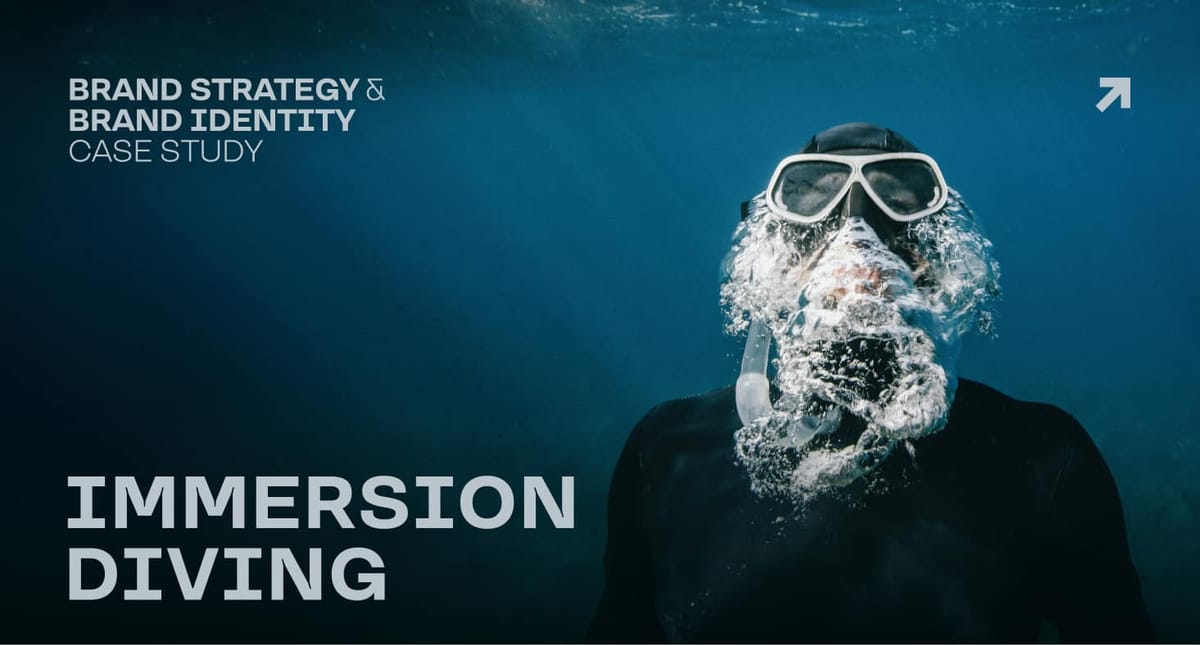
Dive resort marketing is a bit of an anomaly. The product is genuinely extraordinary — think weightlessness, dawn on a reef, or those rare spots where thresher sharks actually show up. Yet, the marketing is almost always interchangeable. It's the same blue gradients, the same tired 'paradise' copy, and a carousel of buoyant guests. Once everyone starts promising paradise, paradise stops being a reason to book.
This is about what actually fills a resort. I'm drawing on common patterns in dive travel, and one project we know inside out: Immersion, a club and resort we branded on Malapascua Island in the Philippines.
Why dive resorts break normal marketing rules
There are four structural quirks that separate this category from generic hospitality:
Seasonality is extreme, almost binary. You're either full or half-empty. The swing is driven by monsoon windows, migration, and how the sharks are behaving, not your social media calendar. If your marketing ignores the season curve, you're just paying to reach people who physically can't get to you.
Buyers are location-dependent twice over. First, they travel to a specific island for a specific event. Then, they pick a resort on that island. You aren't competing with every dive spot on the planet; you're competing with the handful of resorts on your own beach, and the ingrained habits of divers who book via word of mouth or their instructor.
The real barrier is instruction, not price. A huge chunk of your potential guests have never actually dived. Their journey starts with a mix of fear and curiosity, not a search for a hotel room. If you only speak to certified divers, you're fighting for a tiny slice of the available demand.
The purchase is emotional; the justification is rational. People book for the feeling — that 'another planet' moment. Then they justify the cost with logistics: the safety record, the gear, the ratios. The best marketing handles both. It sells the emotion, then armours it with proof.
The five levers that matter
1. Direct booking versus the online travel agency (OTA) tax
Online travel agencies solve a discovery problem that most established resorts have already solved, and they charge 15–25% for the privilege. It's simple arithmetic: every direct booking either boosts your margin or funds a better guest experience. You shouldn't abandon OTAs entirely (they're still great for cold demand), but you must make booking direct obviously better. Think instant instructor chat or flexible date changes. Things an OTA simply can't route. Your website's real job is to convert the warm demand that OTAs and word of mouth generate.
2. Visual proof, mostly underwater
Divers choose with their eyes, but they aren't looking at the rooms. Respectfully harvested guest photos and videos are the highest-yield assets in this category. UGC does double duty here: it's proof, and it's distribution. Every tagged guest is broadcasting to the exact audience that actually trusts them. A steady stream of real underwater imagery will beat polished, drone-shot sameness every time.
3. Season-proofing demand
The natural instinct in a seasonal business is to push hardest during the high season, exactly when the resort is selling itself. The real opportunity is the opposite: filling the shoulders. This means targeting demand pools with different calendars. Focus on certifications during the low season, or run photography workshops timed to whatever the water is offering. A resort that can sell just 30% of its low season is a fundamentally different business.
4. Instructors and partnerships as channels
The real distribution network in diving is human: instructors, clubs, agencies, and shops. A single club in Vienna that visits every October is worth more than a thousand impressions from some scattergun ad campaign. Treat these relationships as a B2B channel, with specific rates and priorities, because that's exactly what they are.
5. Reviews, where they actually matter
Dive travellers are unusually diligent with reviews, particularly regarding safety and gear. The goal isn't just to 'get more reviews', but to curate the ones that matter. After a course, ask specifically about the instructor and the equipment. Specific reviews answer specific objections; a generic five-star rating doesn't.
Case in point: Immersion, Malapascua
Malapascua is a tiny island in the Philippines with one irreproducible asset: it's the only place where thresher sharks are seen reliably. The competition is intense, and almost everyone is promising the same 'quality experience'.
When we researched the project that became Immersion Diving Club & Resort, the pattern was predictable: identical promises, inconsistent delivery. But the focus groups surfaced something sharper. Divers didn't care about amenities. They talked about discovery and adventure, and above all the feeling of being on another planet. That phrase kept coming up, so we made it the strategic spine.
We built a brand to sell that feeling and nothing else. We chose the name Immersion and the slogan 'Beyond the Unseen', paired with a deep-blue identity that evokes mystery rather than postcard brightness. We positioned the resort on the premium discovery experience, not an amenity checklist. Since launch, growth has come from exactly that: guests who came for the sharks but stayed for the promise of the hidden world below.
The lesson here isn't 'get a nice logo'. It's that on an island of identical promises, the resort that sells a distinct feeling, and proves it at every touchpoint, stops competing on price and proximity.
A diagnostic checklist for owners
Run this honestly against your own operation:
- Can you state your positioning in one sentence a diver would actually repeat? (Hint: 'Great diving' isn't positioning.)
- Does your website lead with underwater proof, and is any of it from real guests?
- What percentage of your bookings are direct, and can you state the direct-booking advantage in one line a guest would quote?
- Which months are your shoulders, and which underwater events could anchor demand in those periods?
- Name your most productive instructor or club relationships. When did you last treat them as a deliberate channel?
- Do your reviews answer the safety and equipment objections in the reviewers' own words?
If you have three or more weak answers, your occupancy problem is a strategy problem, not an ad spend problem.
The deeper pattern
Dive resort marketing usually fails in the same way: it markets the resort instead of the dive. The real product is the transformation: that first breath underwater, a shark at dawn, and the whole planet below. Everything else is just operational support to deliver that. Marketing's job is to make the promise distinct enough to be chosen and specific enough to be kept.
It's standard brand discipline applied to a niche category. But it's the reason one resort on a crowded island can fill its calendar while the one next door, with the same reef and the same boats, just waits for the season to do the work.
Related reading
Why Dive Resorts Need a Brand, Not Just a Logo
Enjoyed this? Get the next one in your inbox
Branding insights from TARNOVSKI — no spam, unsubscribe anytime.