

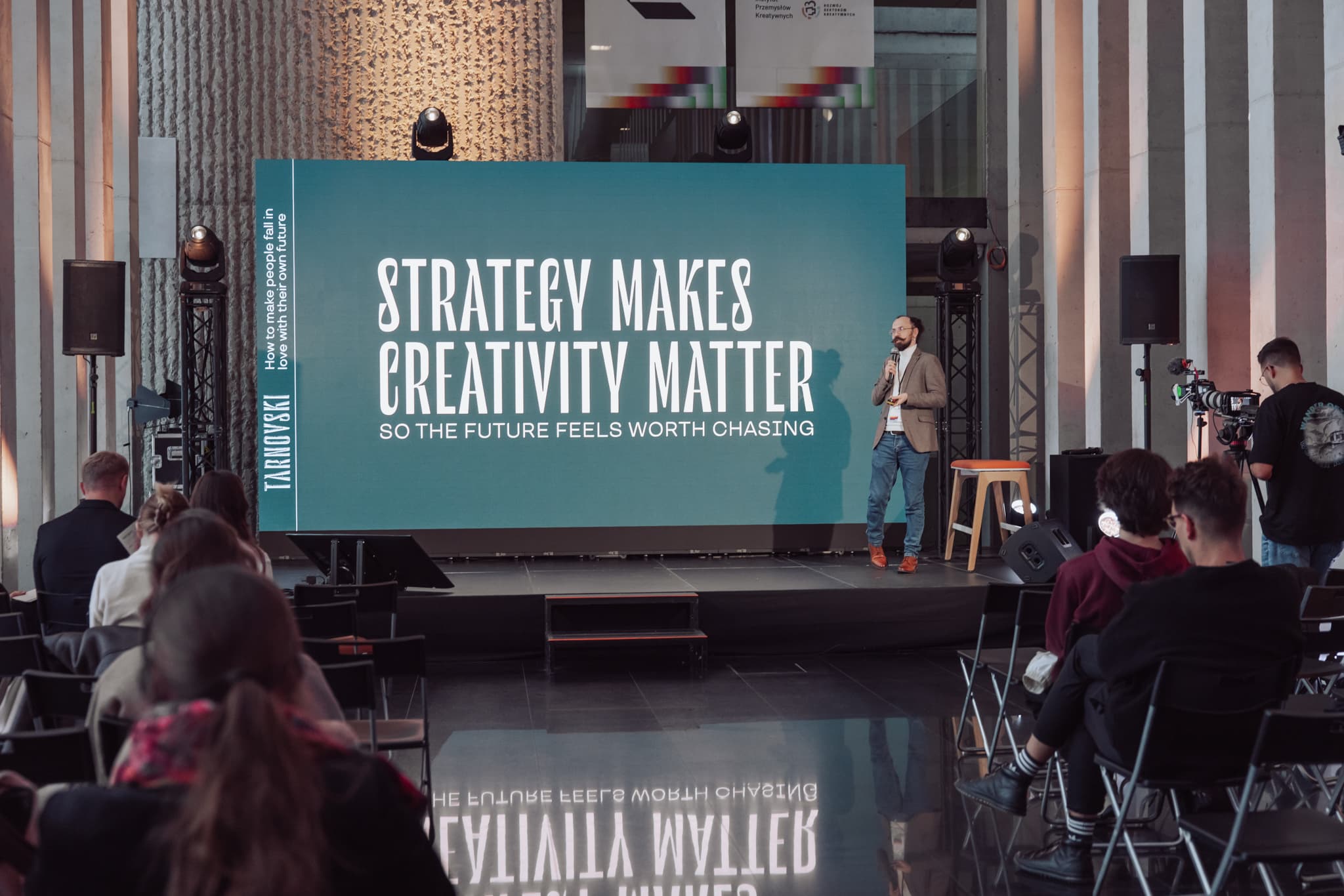
I was recently in Lublin for EastCreative 2025. A solid conference, refreshingly free of the usual festival fluff where we pat ourselves on the back for saving the whales with a poster.
During a coffee break, a well-meaning creative approached me with a question he clearly took very seriously: "How do you convince clients to accept ideas that are 'too bold'?"
That question perfectly diagnoses the sickness in our industry. It is a symptom of that narcissistic fantasy where we, the "artists," are locked in eternal battle with the fearful "bean counters" on the client side.
My answer was short and probably disappointing for him: There is no such thing as an idea that is "too bold." There are only ideas that don't make money.
Clients Aren't Afraid of Creativity, They're Afraid of Stupidity
Let's kill the myth of the conservative client trembling before our creative genius. Marketing execs and entrepreneurs don't reject ideas because they are too brave. They reject them because they can smell them from a mile away for what they actually are: gimmicks. Vanity exercises. Decoration.
Creativity unanchored in strategy is the riskiest asset a company can buy. It’s like hiring an architect who designs a breathtaking house but forgets to include the stairs. Does it look good in the agency's portfolio? Yes. Can you live in it? No.
Creativity without strategy is like a Formula 1 car without a steering wheel: it looks spectacular, sounds powerful, and turns heads, but without control, the only thing it guarantees is a spectacular crash at the first corner.
The most dangerous ideas aren't the boring ones. The most dangerous are the ones that look seductive but solve a problem the brand doesn't have. That’s not boldness. That’s commercial negligence.
Strategy is What Makes Creativity Bankable
In my talk, I argued for a fundamental truth that many ignore: strategy doesn't kill creativity; it makes it sellable. Strategy is what transforms a pretty drawing into a business asset.
I presented three case studies to prove this:
- Moldova Innovation Technology Park (MITP): How do you change the perception of an administrative structure from "rigid bureaucracy" to "engine of a vibrant ecosystem"? How do you make an entire industry attractive to talent, entrepreneurs, and investors alike? But more importantly: how do you shift a country's perception from "just wine" to "innovation and wine"? We didn't solve this by drawing cute logos; but by building a system of values and a clear model of signals and meanings. Because Growth follows belief.
- Castel Mimi – "9 Muses": The wine market is drowning in labels featuring grapes and chateaus. It’s boring, and it’s a sea of sameness. Our strategy wasn't to make a "prettier" label, but to transform the product into a cultural experience. We changed the register. We moved the conversation from "consumption" or "special occasions" to muses, to "divine inspiration"—bringing wine back home to mythology. We traded small, local features (which competitors could easily copy) for a universal cultural truth that has stood for three millennia. And guess what? We created a genuine cultural phenomenon in the market—from art exhibitions involving wine to collaborations with poets and writers, everyone found their own muse.
- The Country Campaign: We identified a strategic barrier—a limiting belief behind a risky narrative regarding refugees—and flipped the script. We took a society that was beginning to show hostility toward newcomers and turned the narrative into "A small country with a big heart." It wasn't an act of creative charity; it was a strategic move of national positioning.
In all cases, creativity amplified the strategy—meaning the direction was clear. When you take this approach, you don't really have to "convince" the client. The client sees the logic. They are already calculating the profit—they "see" how your "crazy" idea will solve a concrete business problem by the end of the year.
The Lesson from the East: Hunger Beats Hype
A final note on what I saw in Lublin. Eastern Europe has a massive advantage right now: groundedness.
I am tired of the polished (and sometimes downright fake) case studies at Cannes, full of purpose-washing, where mayonnaise brands pretend to solve world peace and save the whales. In Poland, Lithuania, Slovakia, and lately, back in Romania (finally), I see a real hunger to do business. The creativity is rawer, more direct, and much more connected to market reality. Not "all" creativity, of course, but we seem to be heading in a good direction.
We aren't trying to save the planet via PowerPoint. We are trying to sell products and build brands that last. And frankly, that is the only creativity that matters.
So, it makes little sense to go looking for "brave" clients. Better to look for smart clients. Better to build them strategies so watertight that "boldness" seems like the most logical and safe option available. Maybe that should become the new strategy for our industry.